
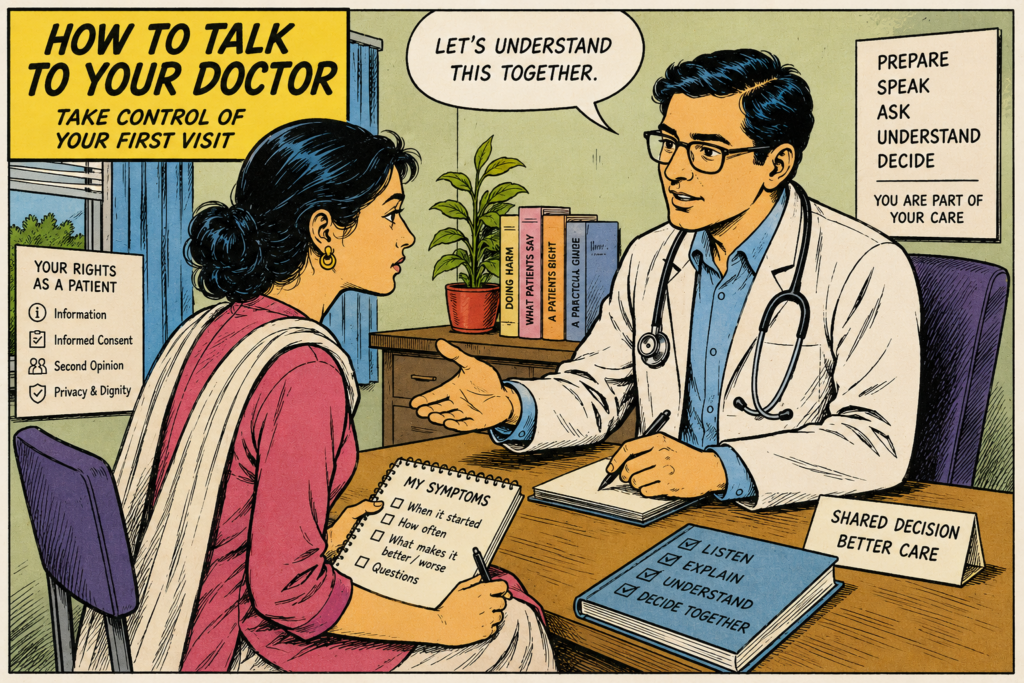
Most first doctor visits fail for one quiet reason: you stop describing your body and start answering the hospital’s agenda. You walk in with a real problem. Within minutes you are nodding, saying “yes doctor,” agreeing to tests you do not understand, and leaving with a prescription — still unsure whether you ever explained what is actually wrong. This happens to many patients. It happens even more often to women visiting a clinic or hospital alone for the first time.
This is not a guide to fight doctors. Good clinicians want accurate information. It is a guide to stop surrendering the conversation — backed by patient-safety guidance from the World Health Organization, shared-decision-making standards from NICE (NG197), health-literacy tools from the U.S. Agency for Healthcare Research and Quality (AHRQ), and India’s own Charter of Patients’ Rights.
The Real Problem: We Hand Over the Story
A medical visit has two jobs. Yours is to report what your body is doing. The doctor’s is to interpret, examine, and advise. Trouble starts when those roles reverse. You wait for the doctor to invent your story. The doctor, short on time, asks leading questions. You answer only what is asked. The visit becomes a quiz you are trying to pass — not a history you are giving.
Classic research helps explain the mechanics. In a widely cited study in the Annals of Internal Medicine, Beckman and Frankel recorded office visits and found that patients were allowed to finish their opening statement of concerns in only 23% of encounters; in 69%, the physician interrupted and redirected toward a specific concern — with potential loss of relevant information.1 Later replications found similar patterns; Marvel and colleagues reported physicians often interrupted within roughly 23 seconds on average.2
That is how patients “lose” the first interaction. Not because medicine is the enemy, but because you stop owning the facts only you know: when it started, how bad it is, what makes it worse, what you already tried, and what you are afraid of.
What “playing into their hands” looks like in real life
- Waiting for the doctor to guess the problem instead of stating one clear chief complaint
- Saying “whatever you think, doctor” before severity, timeline, or red-flag symptoms are on the table
- Agreeing to every blood test, scan, or package without asking why it is needed today
- Hiding intimate symptoms — periods, discharge, pelvic pain, sexual health, anxiety — until the appointment is almost over
- Accepting a diagnosis word you cannot explain to a friend five minutes later
- Leaving without knowing what should improve in 48 hours, or when to return urgently
- Letting a companion (or the absence of one) decide how much of your story gets told
Why Solo Female Patients Lose Ground Faster
Women are not weaker patients. They are often more carefully socialised to be agreeable in authority settings — and the evidence base on dismissal is now public, not anecdotal.
- Parliamentary and news records (UK): A House of Commons Women and Equalities Committee inquiry, reported in The BMJ, concluded that women’s reproductive symptoms are too often dismissed and described “medical misogyny” as unacceptable.4 The Guardian has also reported UK survey findings in which large shares of women said clinicians dismissed pain or symptoms as “normal” or “in their head.”5
- Medical journalism (BBC / Australia): BBC reporting on Australia’s response to gender bias in healthcare documented women labelled “anxious,” “pushy,” or “hysterical,” and cited government survey findings of widespread gender bias in care.6
- Investigative press: Australian masthead investigations have collected large volumes of reader accounts of delayed cancer and serious diagnoses after symptoms were minimised — reflecting a pattern researchers link to male-default research and training, not only individual “bad doctors.”7
- Academic framing: Peer-reviewed work in BMC Medical Ethics treats “medical gaslighting” as a threat to autonomy and beneficence when symptoms are systematically minimised.8 The Lancet obstetrics/women’s health commentary has likewise highlighted dismissal of women’s pain as a structural crisis.9
- Books that synthesise the evidence: Maya Dusenbery’s Doing Harm documents the knowledge gap and trust gap that leave women dismissed and misdiagnosed across conditions from heart disease to autoimmune disease.10 Danielle Ofri’s What Patients Say, What Doctors Hear explains how communication breakdowns — not only technology — drive medical error and missed stories.11
On a first solo visit, politeness training, shame around intimate symptoms, and the authority of a white coat stack together. Preparation is how you keep the visit about your condition.
If you want deeper background before a difficult appointment:
- Doing Harm by Maya Dusenbery on Amazon.in →
- What Patients Say, What Doctors Hear by Danielle Ofri on Amazon.in →
Some links are affiliate links; we may earn a commission at no extra cost to you. Replace TradeTracker campaign/material IDs before publishing.
Your Rights Are Not Rudeness
In India, the National Human Rights Commission’s Charter of Patients’ Rights — adopted into clinical-establishment guidance and published via the Ministry of Health & Family Welfare / Clinical Establishments framework — affirms rights including information, informed consent, and dignity in care.12 Globally, WHO’s Patient Safety Rights Charter (2023) includes the right to information, education and supported decision-making, and the right to patient and family engagement.13
In UK law, the Supreme Court judgment in Montgomery v Lanarkshire Health Board [2015] UKSC 11 held that doctors must take reasonable care to ensure patients are aware of material risks and reasonable alternatives — a patient-centred standard of informed consent, not merely “whatever a responsible body of doctors would say.”14 NICE guideline NG197 on shared decision making and NHS England guidance translate that ethic into everyday practice: decisions should combine clinical evidence with what matters to the person.1516
Asking “why this test?” is not disrespect. It is how consent and safety are supposed to work.
Weak Conversation vs Strong Conversation
| Weak (you lose control) | Strong (you keep control) |
|---|---|
| “I am not feeling well. You tell me, doctor.” | “My main problem is burning urine for four days, with lower tummy pain. No fever.” |
| “Whatever tests you say.” | “Which tests are urgent today, and what will each one change in the plan?” |
| “It is probably nothing.” (while you cannot sleep) | “Pain is 6/10 at night. I missed two days of work.” |
| Mentioning discharge or missed period only at the door | Including associated symptoms in the first minute |
| Leaving with medicines you cannot name | Using teach-back: repeating the plan in your own words before you leave |
Prepare the Night Before (or in the Waiting Room)
AHRQ promotes the teach-back method so patients can state in their own words what they need to know or do — a safety check against misunderstanding medicines and plans.17 The same logic applies before the visit: write your story so interruption cannot erase it.
Also pack these facts
- Last menstrual period date (or menopause status)
- Pregnancy possibility — even if you feel awkward saying it
- Current medicines, supplements, and allergies
- Past surgeries, major illnesses, or hospitalisations
- A photo of rashes, swelling, or old reports if useful
- Home readings if relevant (temperature log; blood pressure if you monitor at home)
- Ruled health / symptom journal on Amazon.in → — write the five-line card and a 48-hour diary
- Digital thermometer on Amazon.in → — bring timed fever readings instead of “I felt hot”
Affiliate disclosure: we may earn a commission at no extra cost to you. Product links are optional supports, not medical devices prescribed by this site. Verify TradeTracker IDs and prefer deeplinks from your affiliate library.
How to Start the Conversation on a First Solo Visit
Do not wait for the doctor to invent your narrative. After a brief greeting, take the first 20–40 seconds. Research on opening statements shows that unfinished agendas cost information;1 your job is to deliver a complete chief complaint before the visit narrows.
Ready-to-use examples
Urinary / pelvic: “I am here alone. Burning while passing urine for four days, lower tummy discomfort, going more often than usual. No fever, no back pain. I drank more water. No antibiotics yet. Periods are regular; last period started on [date]. I am not sure about pregnancy. What do you think this could be, and what should I do next?”
Period pain: “Severe period cramps for the last six months, worse on day one and two. Pain is 8/10; I miss college. Heat and mefenamic acid help partly. No large clots this cycle, but pain radiates to the thighs. I want to know if this is still ‘normal periods’ or needs further evaluation.”
Headache / migraine: “Throbbing headache on the right side for two days, with nausea and light sensitivity. Similar attacks once a month. Sleep is broken. I took paracetamol twice with little relief. No weakness, no vision loss, no fever. What is the likely cause, and when would imaging be needed?”
Anxiety presenting as body symptoms: “For three weeks I have had chest tightness and fast heartbeat, mainly at night. ECG at a local clinic was said to be normal. I also feel dread and cannot sleep. I need help understanding whether this is cardiac, anxiety, or both — and what to do safely next.”
How to Explain Your Condition: The Clinical Order
Use this sequence every time. It matches how medical history is structured, so your words land where the doctor is listening.
| Point | Say it like this | Avoid |
|---|---|---|
| What | Sharp / dull / burning / cramping / spotting / discharge / swelling | “Something is wrong inside” |
| Where | Left lower abdomen / both temples / lower back to leg / under the breastbone | Only pointing without words |
| When | Started Tuesday night; worse after meals / at night / mid-cycle / after exercise | “It has been some time” |
| How bad | 6/10; cannot sleep / work / walk; missed two days | “I can manage” when you cannot |
| Pattern | Constant, waves, only mornings, related to periods | Mixing three unrelated problems at once |
| Associated | Fever, vomiting, discharge, missed period, breathlessness, fainting, weight loss | Hiding “embarrassing” related symptoms |
| Tried so far | Drug names, doses, home care, and result | “I took some tablets” |
| Your concern | “I am worried about infection / pregnancy / something serious” | Silent fear that never gets said |
Symptoms many women under-report — say them early
- Vaginal discharge, odour, itching, or sores
- Pain during sex or bleeding after sex
- Missed, delayed, or unusually heavy periods
- Pelvic pressure, urinary leakage, or incomplete emptying
- Breast lumps, nipple discharge, or skin changes
- Low mood, panic, intrusive thoughts, or exhaustion that is not “just stress”
- Domestic strain or unsafe home situations if they affect health or follow-up (ask for privacy if needed)
How Hospitals Pull You Off Your Story
- Opening questions that narrow too soon — Answer, then return: “Fever yes — but the main problem is…”
- Package thinking — Ask what is indicated for today’s complaint, not a generic master panel
- Computer-first consultations — Pause: “I need you to hear two key points.”
- Companion takeover — “I will speak first; they can add after.” Solo visits require self-advocacy
- Jargon as fog — If you cannot teach the plan back in plain words, you do not yet have a safe plan (AHRQ teach-back principle)17
Stay in Control Mid-Visit: Phrases That Work
- If interrupted: “I will be brief — two more points, then I am ready for your questions.”
- If tests appear instantly: “Which of these are urgent before examination findings, and which can wait?”
- If you do not understand a word: “Please explain that in simple language — what does it mean for me this week?”
- If pressured to decide now: “I want benefits, risks, and alternatives before I agree.” (Montgomery / shared-decision standard)1415
- If labelled without examination: “I hear that possibility. What else could cause the same symptoms, and what are we checking next?”
- If you feel dismissed: “My symptoms are affecting my daily life. I need a clear plan, not only reassurance.”
- Teach-back close: “Just to confirm I understood — I should take [medicine] [dose] for [days], and return if [warning signs]. Is that correct?”
Questions That Stop You Being Led Blindly
- What is the most likely explanation right now?
- What serious problems are we ruling out?
- Why this test or medicine — and what changes if the result is normal?
- What should improve in 24–72 hours if this plan is working?
- Which warning signs mean I must return today or go to emergency?
- Is there a simpler option we can try first if I am stable?
- How should I take this medicine — dose, with food, how many days, and what side effects matter?
- When is my follow-up, and what reports should I bring?
After the Visit: Close the Loop
- Before leaving, confirm medicine names (generic if possible), doses, and duration — then teach them back
- Photograph the prescription if handwriting is unclear — verify at the pharmacy
- Set a phone reminder for follow-up and for “if not better by [date], call/return”
- If you froze and forgot a key symptom, call the clinic the same day and add it to the record
- Keep a short symptom diary for 48–72 hours: pain score, fever, bleeding, sleep, new symptoms
When the Visit Is Not Safe or Not Enough
| Situation | What to do | Urgency |
|---|---|---|
| You cannot finish your history; you feel rushed or mocked | Ask for a pause; request another clinician if needed; seek a second opinion for unresolved significant symptoms | Same day if symptoms are significant |
| Asked to consent to a procedure you do not understand | Do not sign until purpose, risks, and alternatives are clear (informed consent / Montgomery principles) | Before the procedure |
| Severe pain, heavy bleeding, fainting, chest pain, breathlessness, or sudden weakness | Request emergency evaluation immediately | Emergency — call 112 if needed |
| Mental-health crisis, panic, or thoughts of self-harm | Say so directly; ask for urgent psychiatric or emergency support | Emergency |
| You leave confused about diagnosis or medicines | Call back or return; do not guess doses at home | Within 24 hours |
| Symptoms worsen despite following the plan | Return earlier; bring your symptom diary | Prompt |
A Practical Checklist You Can Screenshot
- ☐ One-sentence chief complaint written down
- ☐ Timeline, severity, and impact written down
- ☐ Medicines / remedies already tried listed
- ☐ LMP / pregnancy possibility noted if relevant
- ☐ Two questions I will ask before leaving
- ☐ I will speak first for 30–60 seconds
- ☐ I will ask why for any major test or procedure
- ☐ I will teach-back the plan before I leave
- ☐ I will leave knowing warning signs and follow-up timing
Frequently Asked Questions
Is it rude to speak first or interrupt a doctor?
No. A short, organised opening helps the consultation. Studies of medical interviews show unfinished opening statements risk losing concerns;1 politeness is clarity, not surrender.
What if I freeze when I am alone?
Read from your phone notes. Say: “I wrote this down because I get nervous.” Ask reception whether a patient counsellor or female attendant can sit in if that helps you speak.
Should I hide home remedies or pharmacy tablets I already took?
Never hide them. Doctors need names and doses — including herbal products — to avoid interactions and duplicated treatment.
What if the doctor seems annoyed by questions?
You still have a right to understand risks and options under patient-rights charters and informed-consent standards.1214 If the relationship feels unsafe, seek another clinician.
Can I record the conversation?
Laws and hospital policies vary. Ask permission first. At minimum, write key points and medicine names before you leave.
What if a relative insists on speaking for me?
Thank them, then set the rule: “I will explain first; you can add details after.” Your body, your history.
How long should my opening take?
Thirty to sixty seconds for the core story is enough. If cut off earlier: “Twenty more seconds — then I am done.”
Related Guides
- Hormonal Balance Tips for Women
- UTI Symptoms and Home Care
- PCOS Diet and Lifestyle Management
- Stress Management Techniques
References & sources
- Beckman HB, Frankel RM. The effect of physician behavior on the collection of data. Annals of Internal Medicine. 1984;101(5):692-696. doi:10.7326/0003-4819-101-5-692 · PubMed
- Marvel MK, Epstein RM, Flowers K, Beckman HB. Soliciting the patient’s agenda: have we improved? JAMA. 1999;281(3):283-287. (Often cited with ~23-second mean time to interruption; see also Rhoades et al., J Fam Pract / related replications summarised via PMC1490080.)
- World Health Organization. Patients for Patient Safety; Patient engagement for patient safety. who.int/initiatives/patients-for-patient-safety · Technical series: Patient engagement (Safer Primary Care)
- O’Dowd A. “Medical misogyny” leaves many women in pain, MPs’ inquiry finds. BMJ. 2024;387:q2780. bmj.com/content/387/bmj.q2780
- Topping A. NHS is letting women down through “medical misogyny”, says Wes Streeting. The Guardian. 8 March 2026. theguardian.com/…/medical-misogyny-report
- BBC News. “Hysterical”: The women calling out doctors’ gaslighting. 2024. bbc.com/news/articles/cv229ereeejo
- Aubusson K, Dow A, Kaine E. Medical Misogyny investigation. Brisbane Times / masthead series. April 2025. brisbanetimes.com.au/…
- Medical gaslighting as a threat to beneficence and patient autonomy: a qualitative study. BMC Medical Ethics. 2025. doi:10.1186/s12910-025-01324-z
- Misdiagnosed, dismissed, ignored: the women’s health crisis. The Lancet Obstetrics, Gynaecology, & Women’s Health. 2025. thelancet.com/…/PIIS3050-5038(25)00115-3
- Dusenbery M. Doing Harm: The Truth About How Bad Medicine and Lazy Science Leave Women Dismissed, Misdiagnosed, and Sick. HarperCollins. Author page: mayadusenbery.com/book · Publisher: harpercollins.com
- Ofri D. What Patients Say, What Doctors Hear. Beacon Press. (Physician-author exploration of clinical listening and communication failure.)
- National Human Rights Commission (India). Charter of Patients’ Rights. PDF: nhrc.nic.in/…/charter_patient_rights_by_NHRC_2019.pdf · MoHFW / Clinical Establishments portal: clinicalestablishments.gov.in
- World Health Organization. Patient Safety Rights Charter (World Patient Safety Day 2023; Global Patient Safety Action Plan 2021–2030 context). News: who.int/news/…/patient-safety-rights
- Montgomery v Lanarkshire Health Board [2015] UKSC 11 (11 March 2015). UK Supreme Court case page: supremecourt.uk/cases/uksc-2013-0136 · Judgment PDF: judgment PDF · BAILII: bailii.org
- National Institute for Health and Care Excellence. Shared decision making. NICE guideline NG197 (17 June 2021). nice.org.uk/guidance/ng197
- NHS England. About shared decision making. england.nhs.uk/…/shared-decision-making
- Agency for Healthcare Research and Quality. Use the Teach-Back Method: Tool 5 (Health Literacy Universal Precautions Toolkit). Content reviewed April 2024. ahrq.gov/…/tool5.html